Tag: managing with aloha

  • Beginnings from Rosa Say

    The wonderful Rosa Say gives us some excellent advice this Spooky Season, read below to hear her words of wisdom!

    Aloha mai kākou, and Boo!—Happy Halloween! Let’s talk story. This week, I’m focused on BEGINNINGS, and how well we do them as Alaka‘i Managers. November arrives tomorrow, and it’s a fortuitous time for us to be circling back to ALOHA as our value-driver and best influencer of the winter season. This Hāpu‘u pulu ‘i‘i is just like your Aloha Spirit, tightly curled and regal— and ready to uncoil its abundant promise. —What is the Aloha Spirit? It’s you!


    Ho‘ohana Conversations

    “The great thing about value immersion, is that you don’t lose yourself in it —by the very nature of the values’ ethos, what actually happens, is that you will find more of yourself.”

    When you work within the practice of value alignment, aligning what you believe with what you actually do at work, the values you have chosen are sure to influence you. After all, values are behavior-drivers. Ka lā hiki ola for example (Chapter 19 in Managing with Aloha, “the dawning of a new day”): Within my own years of practice, Ka lā hiki ola has taught me to be rather obsessed about any and all beginnings as a strategic business focus. I talk about it in my newest essay for Ke Ola Magazine’s November/December 2019 issue, and I’m feeling very good about it as a way to prep us this winter in advance for the new year to come.
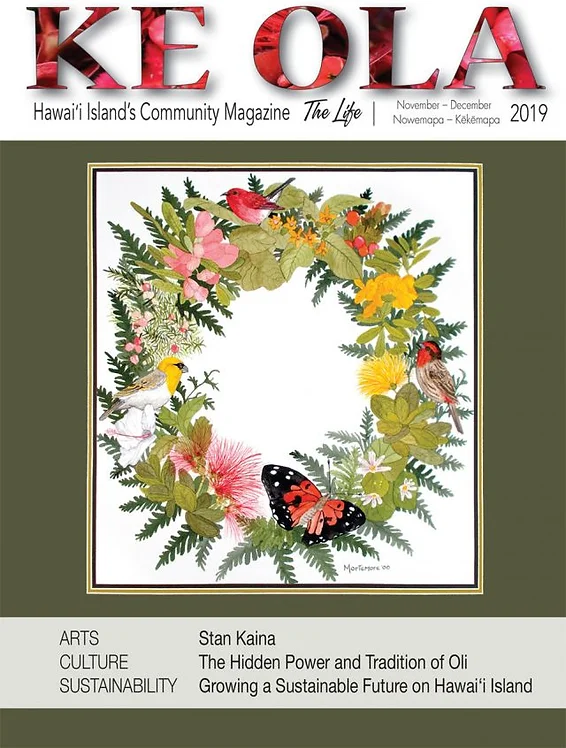
    The essay is titled The Aloha Spirit in Business. <—that link will take you to my website for a sneak peak. On November 1st, you can look for the print edition in the November/December 2019 edition of Ke Ola Magazine at Hawaii Island newsstands, or visit my index at KeOlaMagazine.com.

    Excerpt…This [focus on beginnings] is the real, in-the-trenches, every day way we bring the Aloha Spirit to business. We sweat the details, and we pull apart the myriad of systems, processes, and functions we’re embroiled with, to see them as the person-to-person relational interactions they can be, interactions which get people to feel the Aloha Spirit was what they’ve experienced.

    The “stuff of business” needs to be thought of first and foremost, as interactions where the Aloha Spirit literally comes out to play. One’s Aloha Spirit is a natural people-pleaser. It helps people discover who they innately and humanly are both inside (‘ha’ by nature of their spirit and breath of life) and outside (‘alo’ and in presence, demeanor, and expressed interaction with others). —click for more… 4-5 minute read with the tangible examples of this framing

    Postscript: This has been a busy October of workshops! Did you get homework? If you are a new subscriber, we prepped for this transition to our beginnings in these 2 previous newsletters: On Finishing Well, and The Good Receiver. Mahalo for joining us, and welcome to our Ho‘ohana Community!

    Rapid Fire Learning is our month-end practice: Learn about it here, and skim the index of examples I have published.


    Coming soon: Ho‘omaha for Say Leadership Coaching

    …and for this weekly letter. A head’s up for you on my calendar scheduling: Every year, I temporarily shutter my business Say Leadership Coaching over the winter holidays to devote my full attention to ‘ohana, my family. You may already know it as my annual Ho‘omaha sabbatical: Ho‘omaha Makahiki Kākou <—2016 explainer. This year it will be a little bit longer: my Ho‘omaha sabbatical will run from Thanksgiving week through the end of January 2020. My last weekly letter to you in 2019 will be on November 21st, and they will return to your inbox on February 6th, 2020. (Your subscription remains active unless you unsubscribe.) These won’t be holidays-as-usual, as there are a couple of family projects I must devote my full attention to, and I will also be in ‘immersive edit mode’ on another book I’ve been drafting. I don’t want to say too much about it yet, for I know I need my Ho‘omaha time to clean it up and forge through with the better writing a full-blown book project requires. I love doing these weekly letters, but truth is the week-to-week deadline commitment can interrupt the momentum of the other writing I do for Ho‘ohana Publishing, especially when my business commitments ramp up, which is a good problem to have, as I love my work. Ho‘omaha takes all my ‘can’t write’ excuses away, yet family still comes first, so wish me smooth sailing as I write, edit, write, and edit so’ more. What’s planned for your holidays? I do hope you can ho‘omaha a bit as well.

    “In seed time learn, in harvest teach, in winter enjoy.” — William Blake


    Let’s Take 5: Curated Reading Links

    These are the recent reads-on-the-web related to better work by better humans which have got me thinking…

    Don’t conflate fearlessness with bravery.”

    1. How to ask your mentors for help, Derek Sivers 2. How the “World’s Best Female Chef” Daniela Soto-Innes Is Changing Kitchen Culture, Here Magazine 3. Good managers have learned a LOT from good parenting, and I love these tips: 6 Ways to Raise Brave Boys, Outside 4. Robert Twigger notes, “We live in a one track world but anyone can become a polymath.” Master of many trades, Aeon. “Our age reveres the specialist but humans are natural polymaths, at our best when we turn our minds to many things.” 5. Who are the movers and shakers today? WIRED25: Stories of People Who Are Racing to Save Us, Wired features 25 Makers and Mavericks. “Humanity is facing thorny problems on all fronts. These folks are working to solve them—and trying to avoid the unintended consequences this time.”

    Quote sticking with me lately:

    “The difference between a beginning teacher and an experienced one is that the beginning teacher asks, ‘How am I doing?’ and the experienced teacher asks, ‘How are the children doing?’” ― Esme Raji Codell

    Have a great week, we Ho‘ohana Kākou,

    Rosa

  • Work Out Loud by Rosa Say

    Aloha mai kākou, Let’s talk story. This week, let’s talk about one way the ‘me’ of Ho‘ohana becomes ‘we.’ How does the deep work you do, get introduced to your business’s Language of We?

    Ho‘ohana Conversations

    One of the questions I’m fond of asking business owners these days, is if they’re bringing any freshened perspectives to the beginning of the 20s—what are the New Year’s/New Decade’s resolutions they’re entertaining, specifically for the workplace?

    An answer I often hear, has to do with “deep work,” and that owners want their people to dive into the true essence of their missions and visions, being less distracted by the unimportant. In short, they want more focus on the “blood and guts” of what their chosen work’s discipline is all about.

    Oddly, I’m also hearing that these same people want to do away with most of their meetings; they see meetings as time sinks, and as a significant part of the distractions they battle.

    This argument is largely lost on me, for I love meetings. You read that right. I love meetings.

    Listen, I hate bad meetings as much as everyone else does. However I’m a raving fan of good meetings.

    Good meetings are great discussions. In a good meeting, a meeting of the minds happens; bright minds engage and challenge each other, they entertain useful questions and they seek clarity and synergy.

    We all want “deep work” rather than work that skims the surface of issues without resolving them. We want work that progresses in meaningful ways. Yet we have to stop and ask ourselves, how that deep, meaningful, and progressive work actually happens in our organizations.

    It happens when it engages a workplace in its entirety.

    In a good meeting, people work out loud. People share what they’ve been working on: Individual efforts which have chipped away at deep work’s pockets find their fit in the big picture of cumulative work—mission-busting work. People discover ways they can collaborate, ways they may have missed seeing before. People work for the good of the whole, and gain more understanding on why they might have to ‘kill their darlings.” In other words, they focus.

    Don’t be too quick to dismiss your meetings. Ask instead, if you need to reframe and restructure your meetings so they become more useful to you, as this stage where individual work begins to work out loud—work is shared, explained, questioned in a useful way, integrated into larger efforts and expands from individually deep, to collaboratively expansive.

    As a good guideline, meetings should be 10% administrative—think ‘moderated’—and 70% devoted to discussion. The final 20% should be for the decision-making of follow-up, and coming to agreement on what happens next as a direct consequence of the meeting just held.

    Deep work is great. Deep work shared and integrated is even better.


    Related Reading:

    On deep work: Here’s how Cal Newport, author of Deep Work, Rules for Focued Success in a Distracted World, defines “deep work;”

    “Deep work is focused, uninterrupted, undistracted work on a task that pushes your cognitive abilities to their limit. The best ideas and the most meaningful progress come from deep work, not shallow work. —Shallow work answers emails, produces reports, and flits from meeting to meeting. —Deep work creates breakthrough business ideas, exposes new research questions, and solves complex problems.”

    In our Aloha Archives:

    People will often lament that meetings are boring, useless, time-sucking sacred cows, yet let’s get real about this: If true, the meeting itself isn’t the problem, because meetings don’t give themselves. The problem is us, as the meeting givers and takers we are. The good news? It’s a very easy problem to solve. We just need to approach it as skill-building, with the added benefit of culture-shaping communication improvement. Set the goal: “I will be a better meeting planner and giver, and I will be a great meeting participant and follow-up champion.”

    Read more here: Giving Meetings: From “Have to” to “Get to” Pair it with this: Managing Basics: The Good Receiver


    How will you make an impact in the next meeting you attend? Have a great week, we Ho‘ohana Kākou, Rosa


    Can’t get enough Rosa? Go to RosaSay.com and subscribe to her weekly newsletter!

  • The Role of the Manager, Redesigned and Reconstructed

    ** The following is from Rosa Say’s weekly newsletter, to get these directly to your inbox please go here **

    Aloha mai kākou, let’s talk story. One can easily view the world in two camps right now, those who want to return to how things were pre-pandemic as quickly as possible, our ‘old normal,’ and those chomping at the bit for the creation of a ‘new normal.’ I’ve made no secret of where I sit: I want a new normal which is better, in that it’s more sustainable and equitable, not just safer. Truth is, the pandemic didn’t create my views, it simply fortified them: I’ve been on a soapbox talking about management reconstruction (the profession) and business model reinvention for a long time, years which predate my publishing of Managing with Aloha. I’ve written about it as my latest essay for Ke Ola Magazine.

    Ho‘ohana Conversations

    In my Series 3 essays for Ke Ola Magazine, I committed to a focus on work’s detail via Managing with Aloha’s 9 Key Concepts. I’ll add the series introduction link below in case you missed it. The May Through August 2020 issue was distributed earlier this week, and it presents my 5th article for the series as its Business Feature. Here it is for you, in full so you need not click away:

    (A copy is also archived on RosaSay.com: The Role of the Manager, Redesigned and Reconstructed.)

    The Role of the Manager, Redesigned and Reconstructed

    People ask me, “What’s a good jump-start to help me deep dive into a Managing with Aloha practice?”

    First, read the book for an overall picture of what the philosophy is all about, and read it with purpose: What are your goals? Freshly articulate them.

    Second, identify your core values personally and professionally: Understand which beliefs and convictions propel you forward, for they drive your life and your work when pursuing Ho‘ohana, the value of worthwhile work. Identifying your values is the first step to harnessing their energy; get them to help you feel the work you do is for you and on you as your ethos.

    Third, start doing the Daily 5 Minutes immediately, the conversational practice described in Chapter 11 of the book on ‘Ike loa, the value of learning. It will help you become a “good receiver” practicing no-agenda listening as it keeps you connected to the practical relevancy of your everyday work and essential relationships. If you do not have direct reports, do it with your peers. I cannot overstate how useful this is: your Daily 5 Minutes helps you prioritize and “keep it real” with right task/right time focus, illuminating the action steps you need to take each day thereafter as it simultaneously strengthens your partnerships.

    Finally, commit to Key Concept 4, The Role of the Manager Reconstructed, for that’s where the magic of true “with Aloha” management for the better happens. This is the key which opens the door to all 9 concepts. Let’s examine this part of the Managing with Aloha jumpstart more fully.

    Can you guess who has the worst, most useless Job Position Description (JPD) in every company universally, and no matter what the mission and vision of that company may be? Managers.

    They often have no JPD at all, for managers are largely expected to write it for themselves—to show up where needed, and then be there as stopgap or emergency valve. They babysit—everyone cringes when I use that word, yet if they’re honest, they’ll admit that’s what they mostly do. They aspire to leadership by neglecting its foundation in good management.

    Therefore, when we at Say Leadership Coaching take on a coaching project, we initiate the same jumpstart just recommended to you:

    We identify that company’s mission and vision; we identify the core values we need to align all our recommendations and actions with; we teach and coach the Daily 5 Minutes to involve people immediately with difference-making participation; and we take steps to reimagine, redesign, reconstruct and then implement a renewed role for all managers in the company as quickly and as comprehensively as possible.

    Are JPDs a traditional tool in your company? Keep using them IF you continually revise them to ensure they’re relevant and useful. JPDs should be personalized to the mission of your company and to a person’s Ho‘ohana when seen as their professional mission statement. Therefore, I can’t propose a draft for you. Yet I can give you the guideline we share. Use this in your Key 4 reconstruction as goal-setting: Is this result what your JPD would achieve?

    “Managers must own workplace engagement and be comfortable with facilitating change, creative innovation, and development of the human asset. The ‘reconstruction’ we require in Managing with Aloha is so this expectation of the Alaka‘i Manager is both reasonable and possible, and so they can channel human energies as a company’s most important resource, they themselves having the time, energy, and support needed in doing so. Convention may work against us, where historically, people have become managers for reasons other than the right one: Managing people is their calling. A new role for managers must be explicitly valued by the entire organization as critically important to their better success: Managers can then have personal bandwidth for assuming a newly reinvented role, one which delivers better results both personally and professionally, and in their stewardship of the workplace culture.”

    Managers should be creative initiators, coaches and culture stewards. Realistically, they may become babysitters, stopgaps and emergency valves at times, but those become very rare and short-term conditions in reconstruction—even ‘temporary’ and ‘acting’ is unreasonable and unhealthy in workplace cultures managed with Aloha—correct course and/or fill your vacancies quickly.

    The role of the manager has become crucial in our time, when Human Resources is no longer the manager’s stopgap, emergency valve or resource, primarily focused as they are on laws, regulations, benefit costs and negotiation.

    I say, bring it on. I have the utmost faith in Alaka‘i Managers as those who can do ‘human resources’ better than it has ever been done before.

    We ho‘omau kākou.

    Ke Ola Series 3 to date:

    Quote sticking with me lately:

    “In the David-versus-Goliath battle between big and small businesses in America, COVID-19 is, contrary to New York Governor Andrew Cuomo’s recent assessment, no “great equalizer.” It’s a toxin for underdogs and a steroid for many giants.” —Derek Thompson sums up my fears in his article for The Atlantic: The Pandemic Will Change American Retail Forever, one of the best post-pandemic-projection commentaries I’ve read in both content (it’s not just about retail) and due to Thompson’s exceptional writing.

    “Because the pandemic pauses the present, it forces us to live in the future.”

    Have a great week, we Ho‘ohana Kākou, Rosa Say Leadership Coaching | Managing with Aloha | RosaSay.com